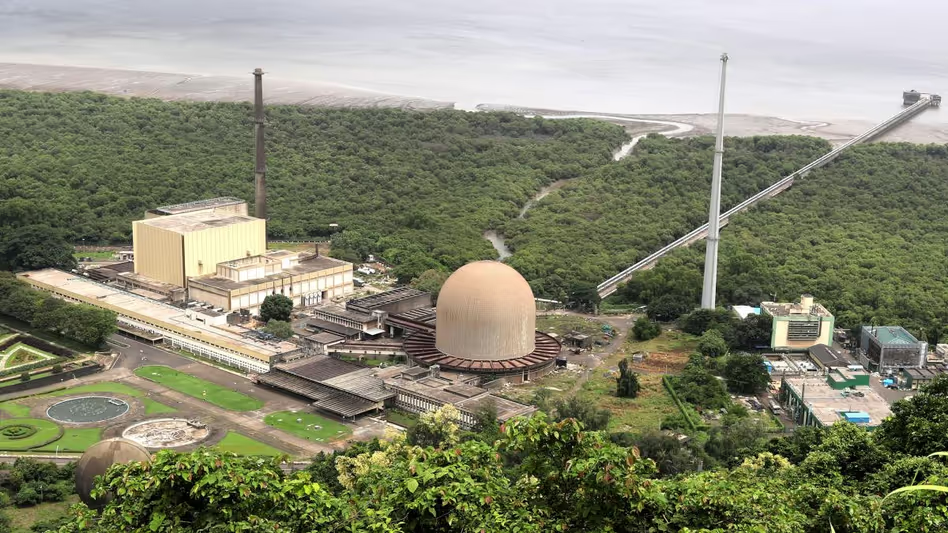
Bhabha, Cold War, Nuclear Technology (1955)
(Strategic Autonomy, Global Cooperation and AI Governance | CLAT 2026 Analytical Brief for CLAT Gurukul)
Introduction
India’s contemporary Artificial Intelligence (AI) ambitions cannot be viewed in isolation from its historical experience with strategic technologies. In a reflective column published in The Indian Express, strategic affairs analyst C. Raja Mohan draws parallels between India’s nuclear trajectory during the Cold War and its present AI strategy. By invoking Homi J. Bhabha and the 1955 UN Conference on the Peaceful Uses of Atomic Energy in Geneva, the article situates India’s AI aspirations within a longer history of balancing national interest and international cooperation.
The core tension identified is familiar: the desire for global collaboration in cutting-edge technology versus the imperative of safeguarding national autonomy in a world shaped by geopolitical rivalry. In the Cold War era, nuclear technology was the frontier of power. Today, AI occupies that role. The article argues that India must learn from its nuclear past to navigate the AI present.
For aspirants preparing under CLAT Current affairs 2026 and Current Affairs 2026, this article offers a rare intersection of international relations, strategic autonomy, technological sovereignty, and public policy. Students enrolled in the best online coaching for CLAT and online coaching for CLAT should approach it as both historical analogy and contemporary policy critique.
Why in News
The issue is in news because:
- India hosted the AI Impact Summit 2026 in New Delhi.
- AI is increasingly central to global strategic competition, particularly between the United States and China.
- India is expanding compute capacity and international technology partnerships.
- There is growing debate over export controls, supply chains, and technological sovereignty.
- The article links India’s AI trajectory with its nuclear diplomacy during the Cold War.
Point-wise Summary of the Article
- The Core Tension in AI Policy
The article identifies an inescapable contradiction:
- The aspiration for collective solutions in AI development.
- The need to protect national interests amid geopolitical rivalry.
This mirrors Cold War-era technological competition.
- Historical Parallel: 1955 Geneva Conference
- In 1955, during the Cold War, India participated in the UN Conference on the Peaceful Uses of Atomic Energy in Geneva.
- Homi J. Bhabha played a leading role.
- Bhabha advocated:
- Access to advanced nuclear technologies for developing nations.
- Peaceful applications of atomic energy.
- Indigenous capability building.
The analogy suggests AI today is equivalent to nuclear technology in 1955.
- Bhabha’s Strategic Vision
Bhabha recognised:
- Technology geopolitics shapes global regimes.
- Domestic capacity is essential for strategic autonomy.
- International partnerships are indispensable.
His dual approach:
- Bridge-builder globally.
- Nation-builder domestically.
- Lessons from Nuclear Experience
India’s nuclear programme:
- Initially advanced with foreign collaboration.
- Faced setbacks due to geopolitical constraints.
- Achieved long-term strategic capability through indigenous development.
The cautionary element:
- Overdependence can lead to isolation.
- Domestic R&D is critical.
- Present AI Landscape
India is:
- Expanding compute capacity.
- Collaborating with the United States and other advanced economies.
- Deeply integrated into Silicon Valley ecosystems.
- Seeing Indian engineers lead global AI research.
However:
- India lacks strong domestic GPU manufacturing.
- External partnerships remain crucial.
- The Risk of Confusion
The article warns:
- India cannot afford strategic ambiguity.
- AI strategy must balance:
- Universalist ideals.
- National capability.
Pure nationalism or pure globalism would both be inadequate.
- US–China AI Rivalry
- Export controls.
- Non-proliferation-like norms for AI.
- Industrial subsidies.
- Supply chain weaponisation.
The AI domain is increasingly shaped by great power competition.
- Threefold Imperative for India
The article proposes three key priorities:
(1) Accelerate National Capability
- Expand compute infrastructure.
- Strengthen research ecosystems.
- Train skilled manpower.
- Provide regulatory clarity.
(2) Deepen International Partnerships
- Collaborate especially with the United States.
- Engage advanced economies.
- Avoid isolating engagement with adversaries.
(3) Shape Global Governance
- Contribute substantively to AI governance debates.
- Ground rhetoric in practical experience.
- Global South Dimension
- A significant portion of the Global South resides in India itself.
- If India accelerates domestic AI development, it can lift other developing nations.
- India could transfer models to other parts of the world.
- Avoiding Past Mistakes
Early nuclear ambitions:
- Overestimated technological bridge-building.
- Underestimated geopolitical fragmentation.
AI must not repeat this pattern.
- Final Strategic Recommendation
India should:
- Anchor global ambition in national capability.
- Weave universalism with nationalism.
- Pursue shared progress without sacrificing autonomy.
Strategic and Policy Analysis (CLAT-Oriented)
- Strategic Autonomy
India’s long-standing doctrine:
- Maintain independence in global alignments.
- Avoid excessive dependence on any single power bloc.
AI strategy must reflect this tradition.
- Technology as Power
AI affects:
- Military systems.
- Economic productivity.
- Political influence.
- Information ecosystems.
Technological sovereignty equals geopolitical leverage.
- Export Controls and Non-Proliferation
AI resembles nuclear technology in:
- Strategic sensitivity.
- Export-control regimes.
- Risk of capability denial.
India must navigate such restrictions diplomatically.
- Domestic Capability Building
Essential components:
- GPU infrastructure.
- Research funding.
- Indigenous chip manufacturing.
- Academic–industry collaboration.
- Governance Leadership
India must:
- Participate in global AI norm-setting.
- Avoid mere rhetorical positioning.
- Contribute through applied experience.
Legal and Constitutional Dimensions (For CLAT Aspirants)
- Economic Sovereignty
Industrial policy and strategic technology affect:
- Economic self-reliance.
- National development objectives.
- Regulatory Clarity
AI governance must balance:
- Innovation freedom.
- Data protection.
- Ethical safeguards.
- International Law
AI norms may evolve similar to:
- Nuclear non-proliferation frameworks.
- Technology export agreements.
Key Themes for CLAT 2026
- AI and Geopolitical Rivalry.
- Strategic Autonomy in Technology.
- Lessons from Cold War Nuclear Policy.
- Global Governance of Emerging Technologies.
- Balancing Universalism and National Interest.
This article is highly relevant under CLAT Current affairs 2026 and Current Affairs 2026, particularly for analytical and passage-based questions.
Critical Evaluation
Strengths of the Argument:
- Historical depth.
- Realistic assessment of geopolitical tensions.
- Balanced approach to cooperation and autonomy.
Challenges Ahead:
- Infrastructure gaps.
- Funding limitations.
- Managing US–China competition.
- Translating rhetoric into domestic innovation.
Conclusion
India’s AI ambitions mirror the strategic dilemmas of its nuclear past. The lesson from 1955 is clear: international engagement must complement domestic capability. Bhabha’s model of bridging global cooperation with indigenous strength remains instructive.
In the AI era, India must avoid simplistic binaries. It should neither retreat into isolationism nor surrender strategic autonomy. Instead, it must weave national capability with global ambition — anchoring universal aspirations in domestic strength.
For aspirants preparing through the best online coaching for CLAT and online coaching for CLAT, this issue offers a rich analytical framework linking history, geopolitics, technology policy, and constitutional governance — making it a high-probability topic under CLAT Current affairs 2026.
Notes: Explanation of Peculiar Terms
- Strategic Autonomy: Policy of independent decision-making in foreign affairs.
- Export Controls: Restrictions on transfer of sensitive technologies.
- Non-Proliferation: Preventing spread of strategic technologies (originally nuclear).
- Compute Capacity: Computational power available for AI training.
- Universalism: Cooperation-oriented global approach.
- Industrial Subsidies: Government financial support to strategic industries.
- Technological Sovereignty: National control over critical technologies.