Nicobar Project-Strategic Imperatives and Ecological Consequences
A CLAT 2026 Analytical Brief
(Environment, Development Policy and Constitutional Governance | For CLAT Current Affairs 2026)
Introduction
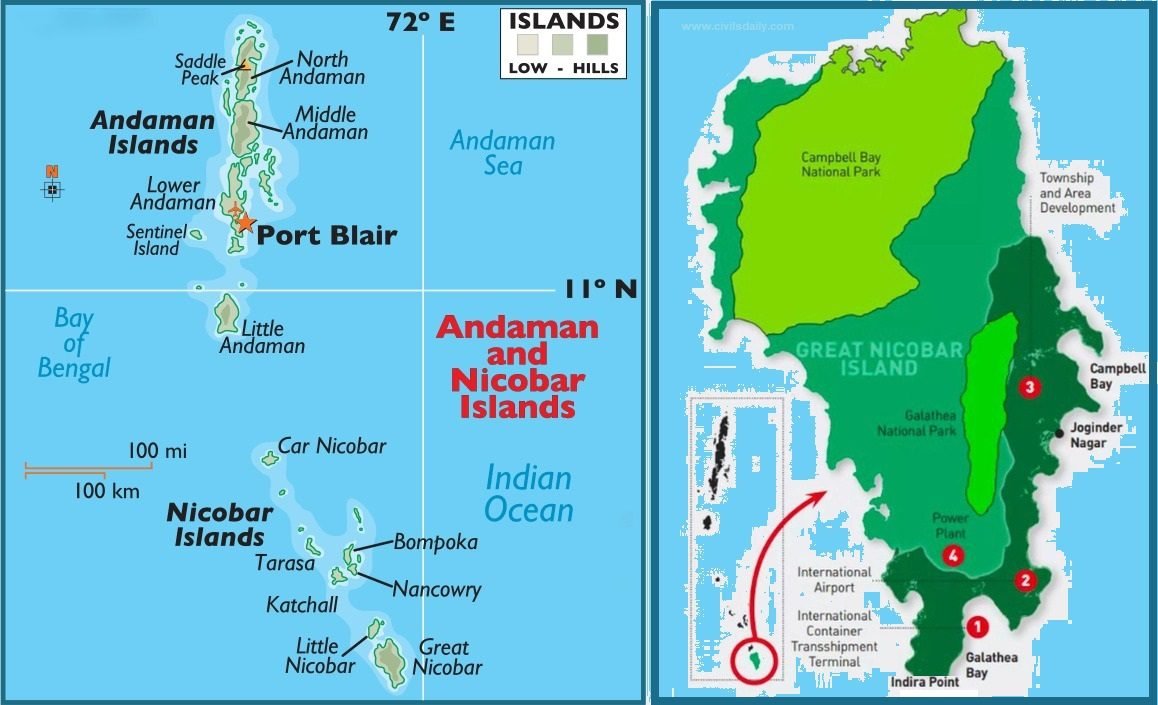
India’s proposed mega infrastructure project on Great Nicobar Island has emerged as one of the most debated development initiatives in recent years. Positioned as a strategic and economic hub in the Bay of Bengal, the project promises to enhance maritime security, trade logistics, and regional connectivity. However, it simultaneously raises serious ecological, tribal rights, and environmental governance concerns.
The issue gained prominence after the National Green Tribunal (NGT) declined to stay the environmental clearance granted to the ₹81,000-crore Great Nicobar mega project, despite acknowledging the ecological sensitivity of the region.
For aspirants preparing for CLAT Current affairs 2026 and Current Affairs 2026, this topic is highly relevant because it intersects environmental law, constitutional principles, sustainable development, tribal autonomy, maritime geopolitics, and strategic policy planning. Students enrolled in the best online coaching for CLAT and online coaching for CLAT must understand both developmental and environmental dimensions critically.
Why in News
- The National Green Tribunal (NGT) declined to stay environmental clearance granted to the Great Nicobar mega project.
- Petitioners argued that “adequate safeguards” were not included in the environmental clearance.
- The project requires diversion of nearly 130 sq km of forest land and felling of almost one million trees.
- The region is part of a globally significant biodiversity hotspot.
- Strategic and defence implications make it a geopolitically sensitive initiative.
Point-wise Summary of the Article
- The Great Nicobar Mega Project
- Estimated cost: ₹81,000 crore.
- Total island area: 910 sq km.
- The project includes:
- A township (149.6 sq km).
- A dual-use international airport (8.45 sq km).
- A transshipment port (7.66 sq km).
- A solar power plant (0.39 sq km).
It is implemented by NITI Aayog through the Andaman and Nicobar Islands Integrated Development Corporation.
- Environmental Concerns
- Nearly 130 sq km of forest land to be diverted.
- Almost one million trees to be cut.
- The Nicobar Islands are part of the Sundaland biodiversity hotspot.
- Habitat of the Nicobar megapode (a ground-dwelling bird found only in the Nicobars) will be affected.
- The project area includes coastal wetlands, mangroves, and evergreen forests.
- Impact expected on nesting grounds of leatherback turtles.
- Tribal and Indigenous Impact
- Indigenous communities: Shompen and Nicobarese tribes.
- Concerns of displacement and loss of traditional land.
- The 2004 tsunami deeply affected these communities.
- Allegations by tribal council that free, prior and informed consent has not been adequately secured.
- Risk of cultural and ecological marginalisation.
- Strategic Significance
- Great Nicobar is India’s southernmost territory.
- Located close to the Malacca Strait.
- Around 40,000 ships pass annually through this route.
- The transshipment port aims to compete with Colombo, Singapore, and Port Klang.
- The project strengthens India’s maritime presence in the Indo-Pacific.
- Defence Imperatives
- Expansion of naval and air force infrastructure.
- INS Baaz airstrip already operational.
- Tri-services command in Andaman and Nicobar Islands.
- Infrastructure seen as part of broader Indo-Pacific strategic positioning.
- Economic Objectives
- Make India a maritime logistics hub.
- Reduce dependence on foreign transshipment ports.
- Boost employment and regional economic development.
- Attract global shipping lines.
- Ecological Fragility
The island is:
- Part of Great Nicobar Biosphere Reserve.
- Home to endemic flora and fauna.
- Ecologically rich but sparsely populated.
Large-scale infrastructure may irreversibly damage ecosystems.
- Governance and Environmental Clearance
- Environmental clearance granted with safeguards.
- NGT acknowledged ecological sensitivity but declined to stay clearance.
- Questions remain about adequacy of mitigation measures.
- Debate over balancing development with conservation.
Legal Dimensions (Important for CLAT Aspirants)
- Environmental Protection Framework
- Environmental Impact Assessment (EIA) process.
- Forest Conservation Act.
- Wildlife Protection Act.
- Coastal Regulation Zone (CRZ) norms.
- Role of National Green Tribunal (NGT)
- Specialised body for environmental disputes.
- Reviews environmental clearances.
- Can stay or modify projects.
- Here, declined to halt the project.
- Tribal Rights and Constitutional Protection
- Fifth and Sixth Schedule protections (though A&N Islands are special administrative territories).
- Forest Rights Act principles.
- Requirement of Free, Prior and Informed Consent (FPIC).
- Sustainable Development Doctrine
Supreme Court jurisprudence recognises:
- Precautionary Principle.
- Polluter Pays Principle.
- Inter-generational equity.
The project tests these principles.
Strategic Analysis for CLAT 2026
- Development vs Ecology Debate
This project reflects the classical tension between:
- National security and economic growth.
- Environmental conservation.
- Tribal autonomy.
- Indo-Pacific Geopolitics
- Malacca Strait chokepoint.
- China’s maritime expansion.
- India’s Act East Policy.
- Quad and Indo-Pacific partnerships.
- Blue Economy
- Maritime trade.
- Coastal infrastructure.
- Sustainable ocean resources.
- Climate and Disaster Vulnerability
- Great Nicobar is earthquake and tsunami prone.
- Infrastructure resilience concerns.
- Long-term ecological impact.
Critical Evaluation
Arguments Supporting the Project:
- Strategic maritime positioning.
- Reduced dependency on foreign ports.
- Defence infrastructure enhancement.
- Economic upliftment of remote territory.
Arguments Against:
- Massive ecological destruction.
- Threat to endemic species.
- Tribal displacement risks.
- Disaster vulnerability.
- Long-term environmental costs.
Comparative Constitutional Insight
Indian judiciary has repeatedly emphasised:
- Environmental protection under Article 21.
- Balancing development with ecology.
- Protection of indigenous communities.
The Nicobar case could become a landmark example of judicial balancing.
Conclusion
The Great Nicobar mega project represents a defining moment in India’s development trajectory. It encapsulates the intersection of geopolitics, environmental sustainability, indigenous rights, and economic ambition. While strategic imperatives are undeniable, ecological fragility cannot be underestimated.
The ultimate test lies in whether India can design a model of infrastructure expansion that genuinely integrates environmental safeguards rather than treating them as procedural formalities. For aspirants preparing under the best online coaching for CLAT and online coaching for CLAT, this issue is a multidimensional case study for CLAT Current affairs 2026 and Current Affairs 2026.
Notes: Explanation of Peculiar Terms
- Biodiversity Hotspot: Region with high endemic species and significant habitat loss.
- Transshipment Port: Port where cargo is transferred between ships.
- Endemic Species: Species found only in a specific geographical region.
- Free, Prior and Informed Consent (FPIC): International standard ensuring indigenous community consent before development projects.
- Precautionary Principle: Preventive action in case of environmental uncertainty.
- Polluter Pays Principle: Those causing environmental harm must bear the cost.
- Biosphere Reserve: Protected area promoting conservation and sustainable use.
- Coastal Regulation Zone (CRZ): Regulatory framework governing coastal land use.